
Reviewed · KOH TAO & KOH NANGYUAN DAY TRIPS FROM KOH SAMUI
Discover Scuba diving with 2 dives on Koh Tao
Two underwater sessions, zero stress. This Koh Samui-to-Koh Tao-style intro water program keeps it practical, with round-trip hotel transfers and all scuba gear provided. You’ll get a chance to see what breathing underwater feels like, then do two different underwater sessions in one day.
What I like most is how it’s built for first-timers: you start with basic skills in controlled conditions, then move to a deeper open-water-style experience where you can go as far as 12 meters. One thing to consider: you’ll need to complete a health questionnaire, and some conditions (like asthma or heart issues) can rule you out for safety.
The day is also run in a friendly, upbeat way, and the instructor quality really matters here. In particular, Yuan stood out for being kind and clear, and for helping people refresh their scuba “vocabulary” fast. If you want a smooth intro day with no pressure to earn a card, this format is hard to beat.
In This Review
- Key highlights that make this intro scuba day work
- What you’re really buying: two underwater sessions plus real instruction
- Koh Samui hotel pickup: the easiest start to a long day
- Gear and crew: included equipment is a huge value
- The day flow: skills first, then open-water style depth
- What to expect in the water
- Where you go: Mango Bay and Japanese Garden when conditions cooperate
- Depth, timing, and how this can help future certification
- Lunch and the little extras that keep the day enjoyable
- Price and value: why this one adds up
- Who this is best for (and who should think twice)
- Should you book this Koh Samui intro scuba day?
- FAQ
- How many underwater sessions are included?
- Is a scuba certification included?
- Where do the transfers come from?
- What time does the experience start?
- What scuba gear do I need to bring?
- How deep will I go?
- What age is required?
- Do I need to fill out a health form?
- Is it okay to do this soon after flying?
- What happens if weather is poor?
Key highlights that make this intro scuba day work
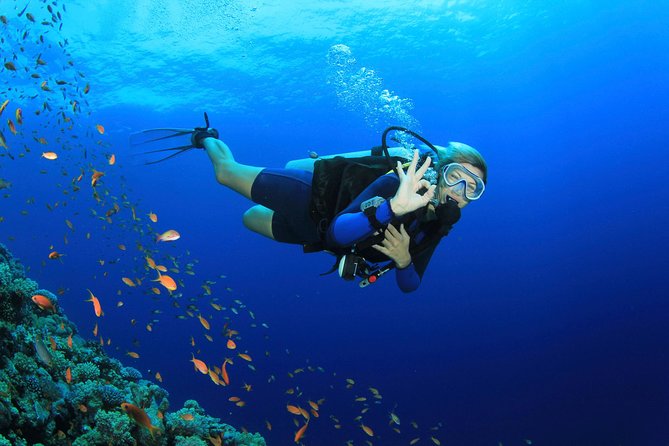
- Two separate underwater sessions in one day, so you get more than a quick taste
- Hotel pickup and return transfers from Koh Samui, which keeps planning simple
- All gear included, so you’re not hunting for rentals or guessing what you need
- Small group size (max 15), which usually means less waiting around
- Clear-water options like Mango Bay or Japanese Garden when conditions allow
- No certification issued, but skills may count toward next steps in formal training
What you’re really buying: two underwater sessions plus real instruction
This is an intro scuba experience designed for beginners and people who want a confident refresher. The pitch is simple: you’ll learn a few basics, then you’ll do two underwater sessions—one tied to skills practice and another in open water—so you’re not stuck repeating the same shallow routine all day.
The “discover” part matters. This isn’t a hard sell to get a certification card on the spot. It’s about letting you feel the gear, control your breathing, and get comfortable with core safety moves under an instructor’s supervision. After the day, you can decide what you want to do next.
You should also know the structure is paced for calm learning. The training includes basic concepts and scuba skills (think mask and regulator basics, plus air-sharing style skills). If you continue later with standard scuba training, those same skills may count toward the next certification step.
Koh Samui hotel pickup: the easiest start to a long day
A lot of scuba plans fall apart at the logistics stage. Not here. Your day starts with round-trip shared transfers from Koh Samui hotels, and the start time is 8:00am.
That matters because you don’t want to burn the morning figuring out where to go, who to meet, and when you’ll be leaving. With this setup, you can show up, sign in, and get into the day’s rhythm.
From the reviews, the whole experience feels like about a full day (roughly 7 hours is a common estimate) and the underwater time per session tends to land around 40–50 minutes. That’s long enough to actually feel what’s going on underwater, not just dip in and pop back out.
One practical tip: go in wearing comfortable clothes you don’t mind getting damp. Even with transfers and crew handling the basics, a day on the water often comes with salt spray and wet gear.
More crossings to Koh Tao and Koh Nangyuan


Gear and crew: included equipment is a huge value
You don’t have to bring anything technical. All scuba gear is provided, and your bottled water and lunch are included too. For me, this is the most underrated part of booking an intro: it removes the guessing game.
If you’ve never used a scuba mask, regulator, or buoyancy system, you’ll want the fit and setup to be correct from the start. Included equipment means you’re using what the crew uses every day, not a random rental someone else returned two months ago.
The instructor also makes the difference between “I’m excited” and “I’m stressed.” One guide mentioned in the reviews, Yuan, was described as friendly and skilled—someone who can reset your basics quickly and keep you calm in the water. That kind of teaching is especially important for first-timers, because confidence is half the technique.
Also, you might want to plan for photos. The staff take photos you can purchase afterward, which is a nice way to remember the day without having to manage a camera rig while you’re learning.
The day flow: skills first, then open-water style depth
The program is designed to build comfort step by step. You’ll learn basic concepts and scuba skills under instructor supervision, then you’ll head into open water for an experience that can reach 12 meters.
Even though this is beginner-friendly, you’re still doing real scuba fundamentals. The goal isn’t to trick you into thinking it’s easy—it’s to help you understand what your body needs to do: breathe steadily, follow directions, and use simple skills like mask clearing and regulator recovery. You’ll also learn an air-sharing style skill, which is a core safety topic in formal scuba training.
Each session is structured so you have time to practice and time to enjoy what you see underwater. Based on review timing, you can expect around 40–50 minutes per underwater session, which is enough for learning and still feeling like you did something meaningful.
What to expect in the water
You’ll typically spend time learning how to control your buoyancy and handle basic equipment while following your instructor’s lead. If you feel nervous, that’s normal. The program is built for that moment—when your brain is figuring out how to coordinate breathing, hand movements, and listening, all at once.
Where you go: Mango Bay and Japanese Garden when conditions cooperate
This experience focuses on clear, calm water spots, and the info highlights Mango Bay and Japanese Garden as options where you can often find good conditions. The key word here is conditions. Your exact sites may depend on what the day offers, because safety and visibility matter.
So what’s the practical takeaway for you? If you’re booking during a time of year when weather is stable, your odds of a smooth experience are better. The program also requires good weather, and if poor conditions cancel the day, you’ll be offered a different date or a full refund.
Under good conditions, these types of sites are great for first-timers because they’re usually easier to manage than rougher water. Clear conditions also make it less stressful to look around and follow what your instructor is pointing out underwater.
More dives and courses over on Koh Tao
Depth, timing, and how this can help future certification
The open-water style portion can go as deep as 12 meters, which is a respectable step for an intro program. It gives you the feeling of real depth and real underwater breathing—without jumping straight into the advanced stuff.
What’s especially valuable is that the skills you practice may be able to count toward later certification steps. The program specifically mentions common safety and technique skills such as:
- Mask clearing
- Regulator recovery
- Sharing air
Even if you don’t know what those terms mean right now, you’ll learn them during the day. And later, when you take the next step in formal training, starting with that foundation can make lessons feel less intimidating.
Timing-wise, you’re usually getting two separate underwater sessions. That matters because your first session is often where you “wake up” to scuba. The second session is where a lot of people feel more coordinated and freer to enjoy the underwater world.
Lunch and the little extras that keep the day enjoyable
Scuba days can turn into a grind if you don’t plan for food and comfort. This one includes lunch and bottled water, which keeps your energy up between the hotel pickup and the later afternoon returns.
From the reviews, it’s also a day that feels welcoming and fun—not stiff, not overly technical. One person booked for a son’s birthday and described the staff as welcoming and the day as top-notch. That’s a good sign if you’re going as a couple, a group of friends, or a family unit where you want smiles, not just checklists.
You’ll also be able to purchase photos. If you’re the kind of person who remembers the lesson but forgets the moment, those pictures can help you keep the memory vivid.
Price and value: why this one adds up
At $245.27 per person, this isn’t the cheapest “try it” option—but it’s also not priced like a private lesson or a full certification course. The value comes from several things that are included:
- Round-trip shared transfer from your Koh Samui hotel
- All scuba gear (no rental headaches)
- Lunch and bottled water
- Taxes and handling charges included
- A day format with two underwater sessions
When you add those parts together, you’re paying for convenience plus instruction plus the equipment setup that makes the day safe and workable for beginners.
Also, you’re not committing to full certification during this day. That’s important value for people who aren’t sure they’ll even like it. If you love the experience, you’ll be able to continue into formal training later with a better sense of what you want.
One more practical note: this is commonly booked about 18 days in advance on average. If you’re traveling in a busy period, I’d book earlier rather than gamble on availability.
Who this is best for (and who should think twice)
This experience is geared toward all levels, but it’s especially well matched to beginners and people working their way up. If you want a cruisier day with clear instruction, this format is built for that.
It also has a minimum age of 13. So yes, it can work for teens—assuming they meet health and fitness needs and can follow instructor directions comfortably.
You should think twice if:
- You have medical conditions that could affect diving safety (asthma and heart conditions are specifically mentioned as examples)
- You’ve flown within 48 hours of the experience start time (it says diving within 48 hours of flying is not recommended)
- You don’t feel you can handle moderate physical fitness demands (the day requires decent baseline stamina)
If you’re unsure, the health questionnaire is part of the process. Use it as a reality check and talk with your doctor if needed.
Should you book this Koh Samui intro scuba day?
If you want a beginner-friendly, instruction-heavy scuba trial with two underwater sessions, included gear, and hotel transfers, I think this is a solid choice. The biggest strengths are practical: it reduces planning stress, it gives you enough water time to learn and enjoy, and the gear is handled for you.
I’d book it if you:
- Want to test whether scuba is your thing before committing to full training
- Prefer a small group day (max 15) over a huge crowd setup
- Appreciate calm teaching and steady guidance from instructors like Yuan, who was praised for friendliness and clarity
I’d hesitate if you’re not able to meet health requirements or you’re trying to fit it in right after flying. In those cases, you’ll have a better experience by waiting until your body is ready.
FAQ
How many underwater sessions are included?
You get two underwater sessions as part of this one-day experience.
Is a scuba certification included?
No. This program is designed to be an intro experience and it does not conclude with a certification.
Where do the transfers come from?
You’ll get round-trip shared transfers from Koh Samui hotels.
What time does the experience start?
The start time is 8:00am.
What scuba gear do I need to bring?
You don’t need to bring scuba gear because all scuba equipment is provided.
How deep will I go?
The open-water style portion takes you as deep as 12 meters.
What age is required?
The minimum age is 13 years.
Do I need to fill out a health form?
Yes. You’ll be required to complete a health questionnaire prior to diving, and some medical conditions may prevent you from participating.
Is it okay to do this soon after flying?
It’s not recommended to do this within 48 hours of flying.
What happens if weather is poor?
The experience requires good weather. If it’s canceled due to poor weather, you’ll be offered a different date or a full refund.
More Tour Reviews in Koh Samui
- Koh Samui: Elephant Sanctuary and Jungle Tour with Lunch★ 4.7 · 1,328 reviews
- Half Day Highlights Koh Samui Tour★ 5.0 · 1,312 reviews
- 2-Hour Koh Samui ATV Quad Tour★ 5.0 · 666 reviews
- Half Day Elephant Home Sanctuary in Samui★ 5.0 · 663 reviews
- Pig Island Tour by Speedboat with Snorkeling★ 4.5 · 530 reviews
Diving Off Koh Tao
- Chumphon Pinnacle-Koh Tao 2 dive trip for certified divers★ 5.0 · 42 reviews
- 2 Days Diving Trip to Koh Tao Including 4 Dives and Accommodation★ 4.5 · 7 reviews
Across to Koh Tao and Koh Nangyuan
- Chumphon Pinnacle-Koh Tao 2 dive trip for certified divers★ 5.0 · 42 reviews
- Full-Day Cruise of Koh Nang Yuan and Koh Tao From Koh Samui★ 3.5 · 38 reviews
- Koh Tao & Koh Nang Yuan Snorkeling Tour by Speed Boat from Samui★ 4.5 · 37 reviews
- Koh Tao & Koh Nangyuan by Speed Boat (Snorkeling trip from Koh Samui)★ 4.0 · 33 reviews
- From Koh Samui: Koh Tao & Koh Nang Yuan Snorkeling (by Speedboat)★ 4.0 · 20 reviews
Just Added: Fresh Koh Samui Reviews
- Ko Samui Full-Day Cultural Tour with Hotel Pickup and Drop Off
★ 5.0 · 3 reviews - MuayThai Private Group
★ 5.0 · 3 reviews - Koh Samui Airport to Koh Phangan by Shared Minivan and Seatran Discovery Ferry
★ 4.5 · 3 reviews - Koh Samui Islands Snorkeling Trip By Speedboat
★ 3.5 · 3 reviews - Full-Day Jeep Safari with the Highlights of Koh Samui
★ 3.5 · 3 reviews - Koh Samui ATV Quad Bike Safari
★ 4.0 · 4 reviews
Koh Tao & Koh Nangyuan Day Trips from Koh Samui, compared.
 ★ 4.7Koh Tao: Islands Snorkeling Highlights Day Tour & LunchFrom $273,742 reviews
 ★ 5.0Full day snorkeling adventure around Koh TaoFrom $242,300 reviews
 ★ 4.6Koh Tao: Koh Nangyuan & Hidden Bays Snorkeling Tour w/ LunchFrom $27912 reviews
 ★ 4.6Ko Tao: Tao-Nangyuan Snorkeling Day Trip with Meals & SunsetFrom $62711 reviews
 ★ 4.8Koh Tao: Snorkeling Trip to Nang Yuan Island & Hidden BaysFrom $24646 reviews
 ★ 4.7Koh Tao: Koh Nangyuan and the Hidden Bays Trip by the OxygenFrom $24305 reviews
 ★ 5.0Snorkel Tour to Koh Nangyuan and the hidden bays of Koh Tao onboard the OxygenFrom $27190 reviews
 ★ 5.0La Bombona Diving Koh Tao Open Water CourseFrom $423172 reviews
Browse the lists this tour appears in